


Much of today's discussion about AI focuses on chatbots, content generation, business automation, and digital assistants.
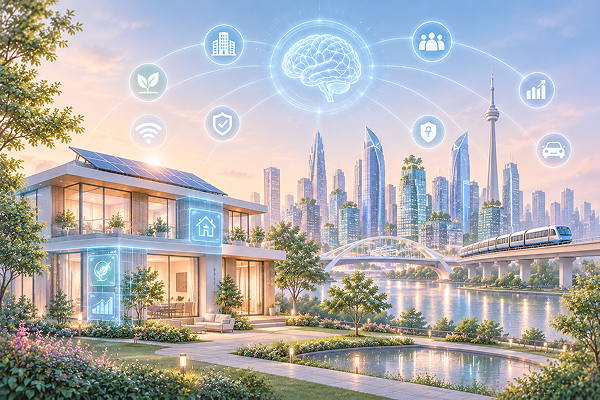
However, one of the most important future developments could be the integration of artificial intelligence into physical infrastructure.
Until now, technology has largely helped us interact with buildings, cities, vehicles, and machines.
The next generation of AI could allow these environments to understand their own conditions, anticipate future requirements, coordinate resources, and adapt continuously.
This creates an opportunity to rethink real estate from its foundations.
Real estate has traditionally been considered a physical asset whose value depends on location, construction quality, design, infrastructure, demand, and economic conditions.
But what happens when a building becomes an intelligent, adaptive system?
What happens when a property is capable of understanding its surroundings, anticipating the needs of its occupants, coordinating with the neighbourhood, and adjusting its physical operations in response to changing conditions?
The industry could move beyond the concept of smart buildings toward something much more ambitious: autonomous, predictive, and continuously adaptive real estate.
The following concepts represent potential future directions rather than established commercial capabilities or guaranteed outcomes. I explore opportunities that go beyond the familiar applications of AI in property searches, chatbots, virtual staging, valuations, and automated marketing.
Five new frontiers that could redefine the future of real estate
A. The self-evolving building: a property that redesigns its own environment
With AI, a future building does not remain physically and operationally static after construction.
Instead, it continuously learns from the behaviour of its occupants and the changing needs of the surrounding environment.
A residential building could recognize that a family needs additional workspace, that an elderly occupant requires safer movement pathways, or that certain common areas are underutilized.
With human approval, the building could coordinate modular interior adjustments, movable partitions, lighting configurations, acoustic arrangements, and environmental controls.
Future buildings could be designed with adaptable architectural components, allowing spaces to change function without requiring major renovations.
A room could transform from a home office into a guest bedroom. A common area could be reconfigured for community activities. An apartment could accommodate changing accessibility requirements as its occupants age.
The underlying concept is a building that evolves with the people living inside it.
This could introduce a new real estate value proposition: not simply buying a fixed floor plan but investing in a property capable of adapting to different stages of life.
B. The predictive property: buildings that anticipate problems years before they become visible
Today, many property problems have become expensive because they are discovered after physical damage has already occurred.
My imagination for a future real estate is a property equipped with an intelligent digital representation that continuously evaluates the condition of its structural components, materials, environmental systems, and surrounding infrastructure.
Rather than simply detecting an existing water leak, such asystem could identify combinations of subtle changes that indicate an increasing probability of future moisture intrusion.
It could assess material defects, changing foundation conditions, unusual vibration patterns, drainage performance, and environmental exposure.
The system could then recommend preventative interventions before visible damage occurs.
An even more ambitious possibility would be a property that maintains a long-term predictive maintenance history throughout its entire lifecycle.
When ownership changes, the new owner could receive a verified record of the building's physical condition, maintenance history, material performance, and projected infrastructure requirements.
This could fundamentally change how buyers, lenders, insurers, and investors evaluate real estate.
A property would no longer be assessed only by its appearance and historical maintenance records. Its future physical reliability could become an important component of its market value.
C. The neighbourhood as an intelligent ecosystem
A property's value is never determined by the building alone.
Its surrounding environment plays an equally important role: transportation, schools, healthcare, commercial services, green spaces, infrastructure, safety, and community development.
A more connected future could enable its buildings and neighbourhood infrastructure participate in a coordinated intelligence network.
Instead of every property operating independently, a neighbourhood could share selected, privacy-protected information about energy demand, water usage, transportation pressure, environmental conditions, and infrastructure requirements.
AI could simulate how a new residential development might affect traffic, local services, electricity demand, and public spaces before construction begins.
It could identify opportunities to coordinate building systems, improve pedestrian connectivity, reduce infrastructure pressure, and make better use of underutilized spaces.
A particularly interesting possibility is the emergence of a neighbourhood adaptability score.
Rather than measuring a neighbourhood only through historical prices, demographic statistics, and current amenities, such a score could estimate how well the area may adapt to future population growth, climate challenges, technological change, and changing household needs.
This could introduce a new dimension to real estate investment: evaluating not just where a property is today, but how resilient its surrounding ecosystem may become over the next 10, 20, or 30 years.
D. The property that negotiates with the city
This is perhaps one of the most unconventional possibilities.
Consider a scenario in which buildings are represented by intelligent digital agents that communicate with municipal infrastructure systems.
A building could coordinate its electricity consumption with the local energy network, adjust certain operations during peak demand, communicate anticipated water requirements, and participate in distributed energy or storage programs.
Additionally, groups of buildings could collectively negotiate energy flexibility, infrastructure usage, and environmental performance within rules established by municipalities and utility providers.
For example, a group of buildings equipped with battery storage could collectively respond to a period of high electricity demand. Isn’t it fascinating?
A development could coordinate its charging infrastructure to reduce pressure on the local grid. Buildings could share surplus renewable energy through approved local energy-market arrangements where regulations and infrastructure permit.
A new category of real estate would appear: the grid-interactive property.
Its value would potentially include not only rental income and appreciation but also measurable contributions to energy resilience and infrastructure efficiency.
E. The intergenerational property: homes designed around the entire human life cycle
Real estate development has traditionally been organized around specific household categories: single professionals, couples, families, retirees, and investors.
But human needs change continuously.
A home purchased by a young professional may eventually need to accommodate a family, remote working, aging parents, or accessibility requirements.
What if an AI-supported architectural system evaluates how a property could serve different occupants over several decades?
Rather than optimizing a home for one particular stage of life, the system could help design flexible spaces that accommodate changing family structures, mobility requirements, privacy needs, and working arrangements.
It could also simulate how a building might support multigenerational living without compromising individual privacy.
Developers could use these models to create housing that remains useful for longer periods rather than becoming functionally outdated as household needs change.
This concept could be particularly valuable in societies experiencing aging populations, housing affordability pressures, and changing family structures.
The future of residential real estate may therefore involve designing homes not simply for the people who purchase them today, but for the different people who may occupy them throughout their lifetime.
A new real estate market: the value of intelligence embedded in physical assets
If these developments become commercially viable, the real estate market could eventually expand beyond its traditional valuation framework.
Today, investors primarily examine location, comparablesales, rental income, development potential, financing conditions, and property characteristics.
Tomorrow, additional considerations could become increasingly important:
This could create a distinction between conventional buildings and what might be called intelligence-ready real estate.
A property with flexible architecture, reliable infrastructure, interoperable systems, and a secure digital record could potentially offer advantages over an otherwise comparable property lacking those capabilities.
However, the market must be careful not to confuse technological sophistication with actual property value.
A building filled with expensive sensors and proprietary software is not automatically a better investment. Its technology must produce measurable benefits, remain maintainable, and avoid creating excessive operating costs or dependence on a single technology provider.
Ultimately, the market will reward useful intelligence, not simply technological complexity.
The new risks: when buildings become intelligent
The integration of AI into real estate will also introduce risks that today's property market is not fully prepared to manage.
Cybersecurity becomes physical security. If an intelligent building relies on interconnected systems, a cyberattack could potentially disrupt access controls, environmental systems, energy infrastructure, or other essential functions. Protecting building technology will become as important as protecting physical structure.
Ownership becomes more complicated. Who owns the data generated by an intelligent property? The homeowner, developer, building manager, technology provider, or occupant? Future property transactions may need clear rules governing data ownership, access, transfer, and deletion.
Technology could create a new affordability divide. Advanced intelligent buildings may offer significant benefits, but their development and maintenance costs could increase housing prices. If these capabilities remain accessible only to wealthy communities, technological progress could deepen existing inequalities.
Automated systems could create hidden discrimination. If intelligent neighbourhood systems use historical information containing social or economic biases, they could reinforce inequalities in resource allocation, insurance decisions, or development priorities.
Technological obsolescence could affect property value. Buildings are designed to last for decades, while software and digital infrastructure can become outdated much faster. Real estate developers will need to consider upgradeability, interoperability, and long-term technology support.
The industry must therefore understand that an intelligent building is not simply a building with more technology. It is a building with a larger digital responsibility.
The question of control: who takes responsibility when AI makes the decision?
As AI becomes increasingly involved in important decisions, the question of accountability will become more important than the question of capability.
Suppose an intelligent building system recommends an action that causes financial damage. Suppose an automated infrastructure system makes a decision that disproportionately affects a particular community. Suppose a property-related AI system incorrectly evaluates environmental risk and influences a major investment decision.
Who is responsible?
The software company? The property owner? The operator? The organization that deployed the system?
These questions cannot be answered simply by improving technology.
They require legal frameworks, ethical standards, independent verification, transparency, and clearly defined human responsibilities.
The more consequential an AI decision becomes, the stronger the requirements for explaination, testing, accountability, and human intervention should be.
Technology should increase the quality of human decision-making, not create a convenient way for people and organizations to avoid responsibility.


